


# ’n Poppy op die heuwel Turns a Burial into a Quiet Fight for Belonging
A new Silwerskerm short film follows two siblings whose attempt to honour their grandmother becomes a confrontation with grief, ownership and a past they are no longer permitted to enter.
A grave is supposed to mark the end of a journey.
In ’n Poppy op die heuwel, it becomes the beginning of a deeply personal struggle over who is allowed to belong to a place — and who gets to decide.
When their beloved grandmother Poppy dies, siblings Laila and Josh return to the Namaqualand farm where they spent most of their lives and where Poppy had lived for more than five decades.
For Laila, there is no question about where her grandmother should be laid to rest.
Poppy belongs beside her own mother, on land where generations of their family once lived.
But the farm has changed hands.
The current owners refuse permission for the burial, turning what should have been an intimate farewell into a dispute between legal ownership and personal inheritance.
Josh, played by Marunzo Thomas, tries to convince his sister that they should abandon the plan.
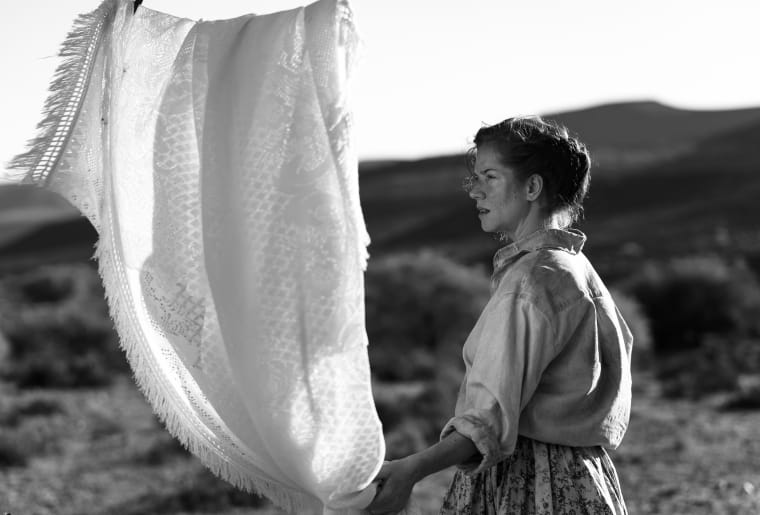
Laila, played by Lauren Joseph, refuses.
If permission will not be granted, she is prepared to take up the spade herself. ([Silwerskermfees][1])
That act gives ’n Poppy op die heuwel its emotional and political weight.
Laila is not simply digging a grave.
She is attempting to recover a place for her grandmother within a landscape from which the family’s connection has effectively been severed.
When Ownership and Belonging Separate
Written and directed by Winford Collings, the drama places grief alongside questions of land, memory and belonging without reducing any of them to a simple argument.
The central conflict is painfully practical:
Where can Poppy be buried?
But beneath it sits something considerably larger.
What happens when the place holding a family’s history no longer has space for the family itself?
For Collings, that tension is inseparable from South Africa.
Discussing the film ahead of its Silwerskerm debut, he explicitly connected Laila and Josh’s predicament to the country’s history of land possession and dispossession — a history whose effects, he argues, continue to surface across generations.
In the film, that history becomes intimate.
Not legislation.
Not a map.
Not a political speech.
A family standing outside the place where its ancestors are buried. ([Silwerskermfees][1])
That is what makes the Namaqualand setting matter.
Land can be privately owned.
Transferred.
Controlled.
Memory does not move so neatly.
A deed can determine who has legal authority over a property, but it cannot erase the lives, relationships and rituals that accumulated there before ownership changed.
Through Poppy’s burial, the film considers the difference between possessing land and belonging to it.
Those ideas can coexist for generations.
Until suddenly they do not.
Grief That Demands Action
Laila’s determination also complicates the language of grief.
Mourning is often represented as an internal process — private, quiet and gradually accepted.
Here, grief demands action.
Her refusal to leave becomes an expression of love, but it also carries consequences.
To honour Poppy, Laila may have to cross a boundary, challenge authority and turn a farewell into confrontation.
Josh brings another emotional register to the story.
His instinct is not necessarily to care less.
It is to recognise the reality standing in their way.
The siblings therefore embody two possible responses to the same loss.
One understands survival as accepting that the place is no longer theirs.
The other believes that accepting that fact would amount to surrendering something that ownership alone should never have been able to remove.
Neither position makes the grief easier.
And neither gives them back the version of home they remember.
The Story Began With Another Grandmother
For all its wider implications, the film began somewhere deeply personal.
Collings says the idea emerged while watching his own mother organise a tombstone unveiling for his grandmother — an occasion that was also intended to become a family reunion.
He watched the pressure of trying to bring everyone together and the responsibility his mother felt to honour his grandmother properly.
That experience became the seed of a story about what people are willing to carry in the name of the dead. ([Silwerskermfees][1])
It also helps explain why ’n Poppy op die heuwel does not treat burial merely as plot machinery.
For Laila, where Poppy rests is inseparable from whether she has been remembered correctly.
The grave is physical.
The obligation attached to it is emotional.
That tension raises one of the film’s more difficult questions:
How much of yourself can you sacrifice while trying to do right by someone who is gone?
Collings himself frames the film partly through that dilemma — the attempt to honour the dead without leaving the living behind in the process. ([Silwerskermfees][1])
When Silence Has to Carry the Story
The film’s restraint extends into its form.
’n Poppy op die heuwel contains very little dialogue and deliberately avoids using mood music to tell audiences what to feel.
For Collings, that is a filmmaking choice rather than an absence.
He has described wanting to use cinema as a visual medium first — trusting a single image to carry a scene when additional dialogue or music would only weaken what is already visible. ([Silwerskermfees][1])
For a story about grief, that silence feels particularly appropriate.
Loss is not always articulate.
Families do not always arrive at the language required to explain what has disappeared.
Sometimes the landscape has to speak.
A face has to speak.
A grave has to speak.
The empty space between two siblings has to carry what neither one can properly say.
That makes Lauren Joseph’s Laila especially important.
Collings says he had Joseph in mind from the moment he began writing, having admired her work in Suidooster and believing she carried the tenacity and fire he needed for the character. ([Silwerskermfees][1])
Marunzo Thomas plays Josh, while Charlene le Roux and Maurice Carpede complete the principal cast.
Deidré Jantjies produces through Winnow Productions, Gray Kotze serves as cinematographer, Michael Bopape is credited with the soundtrack, and Collings edits alongside Shabdeen Cader and Jantjies. ([Film Cape Town][2])
What One Generation Leaves Behind
The film also exists within another kind of inheritance.
’n Poppy op die heuwel forms part of Silwerskerm’s Short Film Project for established filmmakers.
The category gives experienced filmmakers funding and a festival platform, but participation carries a condition: they must mentor less-experienced members of their technical teams.
In 2026, the category is appearing at the festival for the third year. ([Quicket][3])
That places the film within a wider attempt to preserve more than stories.
It also transfers filmmaking knowledge across generations.
For a film concerned with what one generation can leave behind for the next, the parallel is unusually fitting.
Inheritance is not always property.
Sometimes it is memory.
Sometimes it is craft.
Sometimes it is knowledge passed from one person to another before it disappears.
What a Place Remembers
At its heart, ’n Poppy op die heuwel appears to understand that loss is rarely limited to the person who has died.
Laila and Josh are mourning their grandmother.
But they are also confronting the loss of access.
The loss of continuity.
The loss of the assumption that a place connected to your family will remain available to you simply because your memories are there.
That may be the more unsettling grief underneath the burial itself.
A farm can continue existing.
The landscape can remain.
The graves can remain.
The hill can still look familiar.
And yet the people whose history fills that landscape can find themselves standing outside it.
That is what makes Laila’s decision feel larger than defiance.
She is insisting that Poppy’s relationship with the land cannot be erased as easily as ownership can be transferred.
Whether she has the right to act on that belief is part of the tension.
Whether the family can emotionally survive abandoning it is another.
The film does not ask only where Poppy should be buried.
It asks whether belonging can survive ownership.
Whether memory can resist displacement.
What it means to honour the dead without losing yourself in the attempt.
And what it costs to reclaim a past that no longer appears to have room for you.
Sometimes remembrance is quiet.
Sometimes it requires a spade.
’n Poppy op die heuwel screens at the 14th kykNET Silwerskerm Festival on Saturday, 22 August 2026 at 15:15 at Theatre on the Bay in Camps Bay. It will be presented alongside Bosryer and As ek kon kies

Reporting basis: Based on the official kykNET Silwerskerm Festival synopsis and filmmaker interview with writer-director Winford Collings, the festival’s official screening and ticket information, Film Cape Town’s published cast and production credits, and Viranova editorial analysis of grief, land, dispossession, memory and belonging.
Story index Key points, people & topics
Key points & topics
- A new Silwerskerm short film follows two siblings whose attempt to honour their grandmother becomes a confrontation with grief, ownership and a past they are no longer permitted to enter.
- ’n Poppy op die heuwel turns one family’s attempt to bury their grandmother on the land that carries their history into an intimate Silwerskerm drama about grief, ownership, memory and belonging.
Frequently asked Answers from the desk
What is ’n Poppy op die heuwel about?
The short film follows siblings Laila and Josh as they return to a Namaqualand farm after the death of their grandmother Poppy and confront the current owners over their refusal to allow her burial on the land.
Who directed ’n Poppy op die heuwel?
Winford Collings directed the film and also wrote the screenplay.
Who plays Laila in ’n Poppy op die heuwel?
Lauren Joseph plays Laila.
Who plays Josh in ’n Poppy op die heuwel?
Marunzo Thomas plays Josh.
Who else stars in ’n Poppy op die heuwel?
Charlene le Roux and Maurice Carpede complete the principal cast alongside Lauren Joseph and Marunzo Thomas.
Who produced ’n Poppy op die heuwel?
Deidré Jantjies is credited as producer and Winnow Productions is the production company.
Who is the cinematographer of ’n Poppy op die heuwel?
Gray Kotze is the cinematographer.
What inspired ’n Poppy op die heuwel?
Winford Collings says the idea grew from watching his mother organise his grandmother’s tombstone unveiling and family reunion and seeing how heavily the responsibility of honouring her memory weighed on her.
What themes does ’n Poppy op die heuwel explore?
The film explores grief, family memory, land, belonging and the continuing effects of South Africa’s history of land possession and dispossession.
Why does the film use so little dialogue?
Winford Collings says he wanted to use film as a visual medium first and avoid dialogue or mood music where the image could communicate what the scene needed.
Credibility & transparency How this story is reported
- Content type
- News
- Verification
- Official source
- Reporting basis
- Based on the official kykNET Silwerskerm Festival synopsis and filmmaker interview with writer-director Winford Collings, the festival’s official screening and ticket information, Film Cape Town’s published cast and production credits, and Viranova editorial analysis of grief, land, dispossession, memory and belonging.
- Sources & context
- The story draws on kykNET Silwerskerm Festival’s official profile of ’n Poppy op die heuwel, including Winford Collings’ discussion of the film’s origins, its treatment of land possession and dispossession, and its deliberately sparse use of dialogue and music; Film Cape Town’s 2026 production listing; and the official Silwerskerm screening programme.
- Image
- Official Source
- Primary source
- silwerskermfees.co.za
Edited under our Editorial Standards and How We Report process. Spotted an error? Open the correction form below, or email corrections@viranova.co.za.
Request a correction Accuracy desk
Submit a Correction
Corrections are reviewed by editors and logged with the story record.
Human-written · Editor-reviewed · Corrections open
Filed by Viranova Entertainment Desk for the Entertainment desk · Namaqualand, South Africa. Published 15 Aug 2026.
Sources
Secondary material
Reported first by another publication or organisation, and credited here.
- The film follows Laila and Josh returning to a Namaqualand farm to bury their grandmother Poppy, but the current owner refuses permission kykNET Silwerskerm Festival accessed 15 August 2026
- Winford Collings wrote and directed the film and says its themes engage South Africa's history of land possession and dispossession kykNET Silwerskerm Festival accessed 15 August 2026
- Lauren Joseph, Marunzo Thomas, Charlene le Roux and Maurice Carpede star in the film, with Deidré Jantjies producing and Gray Kotze as cinematographer Film Cape Town accessed 15 August 2026
- The film forms part of the Silwerskerm Short Film Project for established filmmakers, which requires participants to mentor less-experienced technical team members kykNET Silwerskerm Festival / Quicket accessed 15 August 2026
- ’n Poppy op die heuwel screens on 22 August 2026 at 15:15 at Theatre on the Bay with Bosryer and As ek kon kies kykNET Silwerskerm Festival / Quicket accessed 15 August 2026
Respond to this story Reactions, comments, corrections
Respond to this story. Share a comment, a correction, or a right-of-reply — comments open once the room starts talking.