

South African music is usually celebrated when it reaches the obvious places: a global stage, a viral moment, a streaming milestone, a sold-out venue, an award-night speech.
But some of the most important work in music happens long before the applause.
It happens when an artist can afford to travel to the next city. It happens when a small venue becomes a reliable cultural room. It happens when a promoter has enough support to take a risk on a live show. It happens when festivals, community spaces, researchers, funders and cultural workers quietly keep the live music economy alive even when the spotlight is somewhere else.
That is why Concerts SA and IKS Cultural Consulting’s 2026 Music Cities Award matters.
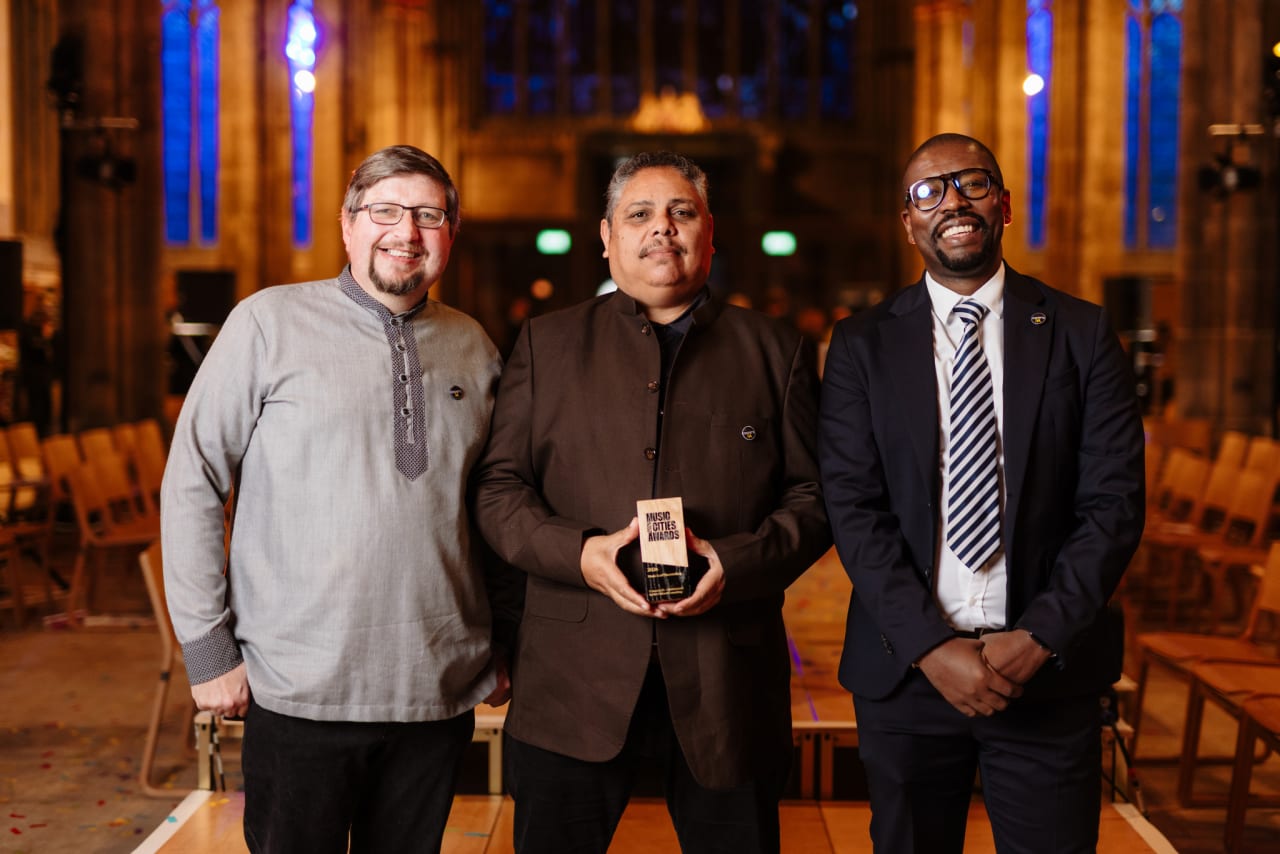
The South African live music development project was honoured in the United Kingdom at the 2026 Music Cities Awards, held during the Music Cities Convention in Hull. Concerts SA and IKS Cultural Consulting were recognised in the Music-Led Placemaking category, a field that looks at how music can strengthen cities, communities, cultural spaces and local economies.
This is not just a plaque for a successful project.
It is an international acknowledgement of something South Africa often underestimates: music infrastructure is culture too.
For more than a decade, Concerts SA has worked in the less glamorous but deeply necessary parts of the music ecosystem. The project has supported artists on the move, helped strengthen venues, invested in audience development, contributed to research, and worked with festivals, promoters and cultural workers across South Africa and the wider region.
The numbers tell part of the story. According to the project, Concerts SA’s work has supported more than 29,000 artists and music-sector practitioners, reached all nine South African provinces, operated across 11 Southern African countries, and helped activate more than 2,000 venues, festivals and community spaces.
But the deeper story is not only in the numbers.
It is in what those numbers mean.
Every touring artist needs more than talent. They need transport, venues, reliable partners, audiences, communication, documentation, and some kind of economic pathway that makes live performance possible beyond one big-city stage. Every healthy music scene needs places where people can gather, hear new sounds, build relationships, test ideas and turn local energy into lasting cultural memory.
That is the space Concerts SA has occupied.
Founded in 2013, the initiative began as a mobility-focused intervention and grew into one of the region’s most important live music development projects. Its work has moved through artist mobility, venue support, research, training, audience growth and broader conversations about the night-time economy.
That phrase, “night-time economy,” may sound technical, but it speaks directly to everyday cultural life. It asks what happens after office hours. Who gets to perform? Which venues survive? Which neighbourhoods become cultural destinations? Which workers earn from live culture? Which audiences feel invited into the room?
In South Africa, those questions are not abstract.
They touch townships, city centres, festivals, independent venues, jazz rooms, community halls, heritage spaces and new creative markets. They touch the difference between a once-off performance and a sustainable circuit. They also touch the gap between South African music being admired abroad and South African musicians being properly supported at home.
That is why this award lands with weight.
For André Le Roux, founder of Concerts SA and managing director of IKS Cultural Consulting, the recognition reflects a long road rather than a sudden arrival.
“There’s a piece of graffiti near the entrance to the Adelphi Club in Hull that reads, ‘You’ve come a long way, baby.’ That resonated deeply,” Le Roux said. “It’s been a long journey, not just the flight from South Africa, but the work of keeping a live music development project alive for more than a decade.”
He also made it clear that the award belongs to a much wider community.
“This award belongs to the thousands of South African artists, venues, promoters, festivals, and cultural workers who trusted this project with their livelihoods and their art. We accept it with humility, gratitude, and a renewed commitment to building sustainable live music ecosystems across Southern Africa.”
That last phrase is important: sustainable live music ecosystems.
South Africa has no shortage of talent. The country produces voices, sounds, scenes and movements that repeatedly travel beyond its borders. Amapiano proved that again. So did jazz, gospel, house, Afro-soul, kwaito, gqom, hip-hop and the many hybrid forms that refuse easy classification.
But talent alone is not an industry.
An industry needs routes. It needs rooms. It needs money that reaches working artists. It needs small and micro-enterprises. It needs festivals that can collaborate instead of competing in isolation. It needs data. It needs training. It needs a live circuit that allows artists to build careers without depending only on one city, one platform or one viral moment.
Concerts SA’s work sits inside that larger argument.
The project’s current and recent work through programmes such as the Festival Enterprise Catalyst shows that the mission has not stopped at recognition. The focus remains on mobility, touring, enterprise development and the long-term sustainability of creative work.
SAMRO CEO Annabell Lebethe described the programme as part of a broader commitment to South Africa’s creative economy.
“Concerts SA continues to play an important role in supporting small and micro-enterprises within the creative sector,” she said. “By investing in artist mobility and live performance opportunities, the programme has helped create meaningful sustainability in the live music industry for more than a decade.”
That is the part worth holding onto.
This award is not only about Concerts SA and IKS Cultural Consulting receiving international applause. It is about the world recognising a kind of cultural labour that is often invisible: the building of the rooms, routes, relationships and systems that allow music to live beyond the recording.
A country’s music culture is not only measured by its stars.
It is measured by whether emerging artists can get on the road. Whether local venues can stay open. Whether audiences can discover live music close to home. Whether festivals can build circuits instead of isolated moments. Whether cultural workers can survive long enough to keep building.
In that sense, Concerts SA’s Music Cities win is bigger than an award.
It is a reminder that South African music does not only need celebration when it succeeds globally. It needs investment before it gets there.
Because live music is not just entertainment.
It is work. It is movement. It is memory. It is community. It is infrastructure.
And this time, that infrastructure has been seen.
Story index Key points, people & topics
Key points & topics
- The international recognition of Concerts SA and IKS Cultural Consulting highlights a truth South Africa often overlooks: music infrastructure is culture too.
- Concerts SA’s Music Cities Award is bigger than an international accolade. It is recognition of the invisible systems, routes, venues and relationships that make live music possible.
- Concerts SA and IKS Cultural Consulting’s 2026 Music Cities Award highlights the infrastructure, mobility and live-music ecosystems that sustain South African music.
Credibility & transparency How this story is reported
Edited under our Editorial Standards and How We Report process. Spotted an error? Open the correction form below, or email corrections@viranova.co.za.
Request a correction Accuracy desk
Submit a Correction
Corrections are reviewed by editors and logged with the story record.
Human-written · Editor-reviewed · Corrections open
Filed by Viranova Music Desk for the Music desk · South Africa / Hull, United Kingdom. Published 17 Jun 2026.

Respond to this story Reactions, comments, corrections
Respond to this story. Share a comment, a correction, or a right-of-reply — comments open once the room starts talking.