

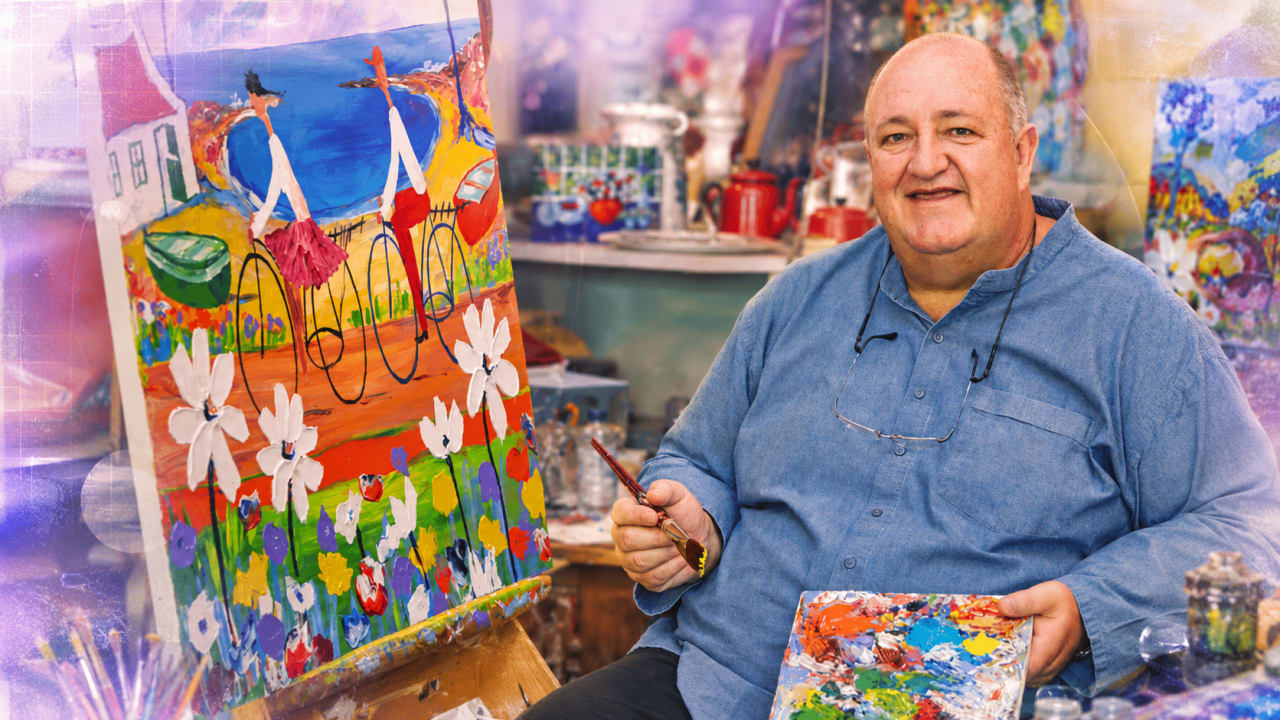
Jan Hendrik Viljoen did not just paint.
He engineered joy.
Known widely as Portchie, the Stellenbosch-based artist who died on 12 June 2026 at the age of 62, achieved something rare in the modern art world: he made happiness feel serious.
His work was stubbornly, joyously colourful. It rejected the idea that art has to be cold, distant or painfully intellectual to matter. Instead, Portchie built a world of vivid canvases, playful scenes, bright trees, warm landscapes and everyday wonder. His paintings felt immediately recognisable because they carried a language of colour that did not need permission from the gallery establishment to connect with people.
That accessibility was part of the point.
Portchie’s work travelled far beyond one kind of audience. It found a home in galleries, collections, merchandise, public memory and international spaces, including exhibitions abroad. His art became synonymous with Stellenbosch, but it also reached people who may never have considered themselves “art people” in the first place.
That matters.
There is a tendency to treat popular art as less serious because it brings comfort. Portchie’s career quietly argued against that. He understood that joy is not shallow. Warmth is not weakness. Beauty does not become less powerful because ordinary people recognise themselves in it.
His passing leaves a bright, unmistakable absence in South Africa’s visual arts landscape.
But the work remains.
The colour remains.
And in a country that has often had to survive through heavy history and daily pressure, Portchie’s refusal to let the shadows win feels like its own kind of artistic courage.
Story index Key points, people & topics
Key points & topics
- Jan Hendrik Viljoen, known widely as Portchie, leaves behind a colourful artistic legacy that made joy, warmth and everyday wonder feel serious.
- Portchie’s passing marks the loss of one of South Africa’s most recognisable visual artists — a painter whose colourful work made joy, warmth and accessibility feel like artistic courage.
- Portchie, born Jan Hendrik Viljoen, has died at 62. His colourful, joyful work leaves a lasting legacy in South African visual art and Stellenbosch culture.
Credibility & transparency How this story is reported
Edited under our Editorial Standards and How We Report process. Spotted an error? Open the correction form below, or email corrections@viranova.co.za.
Request a correction Accuracy desk
Submit a Correction
Corrections are reviewed by editors and logged with the story record.
Human-written · Editor-reviewed · Corrections open
Filed by Viranova Culture Desk for the Culture desk · Stellenbosch, South Africa. Published 14 Jun 2026.

Respond to this story Reactions, comments, corrections
Respond to this story. Share a comment, a correction, or a right-of-reply — comments open once the room starts talking.