

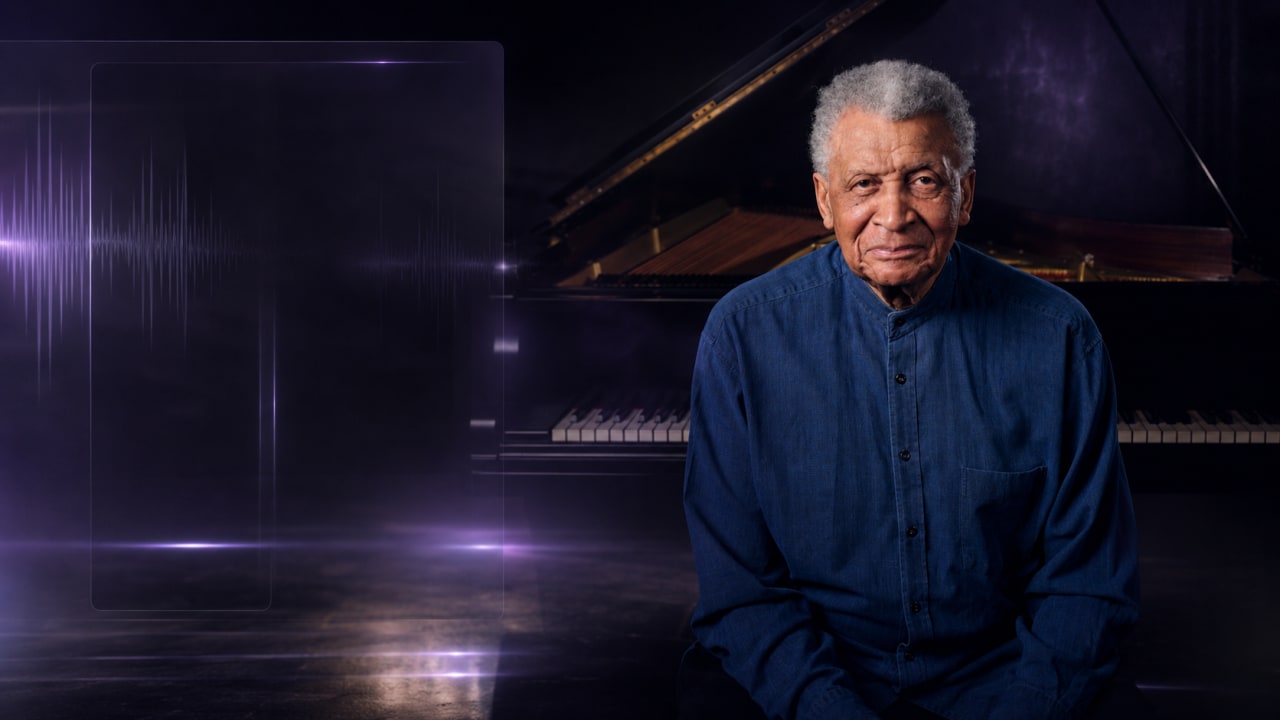
There is a profound, almost defiant composure in the way Abdullah Ibrahim approached the piano.
Where other jazz greats filled the air with frantic virtuosic runs, Ibrahim let the silence do the heavy lifting. He possessed what pianist Vijay Iyer once described as a “fearlessness with quiet.”
On 15 June 2026, that quiet took on a new permanence.
Ibrahim passed away in Germany at the age of 91, marking the end of a physical journey but leaving behind a sonic legacy that essentially maps the modern history of South Africa.
The Cape Town Crucible
Born Adolph Johannes Brand in 1934 in Cape Town, Ibrahim emerged from a city whose sound was already layered with movement, struggle and cultural collision.
His early sonic world was wide. He absorbed church hymns, marabi, mbaqanga, Cape rhythms, township music and the American jazz records that moved through the port city. Before he became Abdullah Ibrahim, he was Dollar Brand — a young pianist whose imagination was already stretching far beyond the rooms apartheid tried to confine him to.
By the late 1950s, performing as Dollar Brand, he had joined forces with musicians including Hugh Masekela in the Jazz Epistles. Their recording, Jazz Epistle Verse One, became a landmark in South African music history as the first full-length jazz LP by Black South African musicians.
That achievement was more than technical.
It was a declaration that South African jazz had its own grammar, its own urgency and its own right to exist on record.
A Tactical Retreat
The tightening grip of apartheid made survival — let alone free artistic expression — nearly impossible for Black musicians.
In 1962, Ibrahim left South Africa. But he did not frame exile as surrender. He famously preferred to call it a “tactical retreat.” He understood himself and his peers not as artists running away, but as cultural freedom fighters finding the space to keep the work alive.
That retreat led him to Europe, where a fateful encounter with Duke Ellington altered his trajectory.
Ellington recognised the depth of Ibrahim’s gift and helped introduce him to a wider international audience. The connection opened doors into global jazz circles, placing Ibrahim in conversation with some of the most important musicians of the twentieth century.
But no matter how far the music travelled, the compass kept pointing back to the Cape.
The Anthem of an Era
Following his 1968 conversion to Islam and his adoption of the name Abdullah Ibrahim, his sound became even more distilled.
It carried silence, discipline, prayer, memory and place.
You hear that most powerfully in “Mannenberg.”
Recorded in 1974 during a brief return to South Africa, the track became one of the great musical documents of the anti-apartheid era. It did not rage in an obvious way. It breathed. It strut. It moved with the unhurried confidence of people who had not yet been freed, but already knew freedom was possible.
“Mannenberg” became widely known as an unofficial anthem of resistance. The recording reportedly reached Nelson Mandela during his imprisonment, and Ibrahim would later perform at Mandela’s 1994 presidential inauguration.
That arc matters.
A song born from Cape jazz became part of the emotional architecture of a country imagining itself beyond apartheid.
The Architecture of Sound
What made Ibrahim’s music so arresting was not only its political weight.
It was the architecture of the sound itself.
He merged the dissonant, angular intelligence of modern jazz with the rolling, hymnal warmth of South African musical memory. His music often seemed to live between ancient tradition and modern improvisation, between prayer and protest, between a township street and a spiritual clearing.
You did not just listen to an Abdullah Ibrahim performance.
You inhabited it.
He could sustain a solitary chord until it felt like a revelation, letting the overtones shimmer and fade before placing the next note with devastating restraint.
In a culture often obsessed with noise, speed and spectacle, Ibrahim reminded us that quiet could be radical.
A Blueprint for Dignity
His passing strips the world of a singular elder statesman.
He survived the erasure of District Six, the brutality of apartheid, the displacement of exile and the long ache of distance from home. Yet his music remained remarkably free of bitterness.
Instead, it offered a blueprint for dignity.
Abdullah Ibrahim leaves behind a vast catalogue, but his true monument is larger than numbers. It is the shelter his music still provides. The reflection. The restraint. The spiritual weight. The quiet, unrelenting power.
South Africa has lost one of its great musical architects.
But the silence he shaped is still speaking.
Story index Key points, people & topics
Key points & topics
- Abdullah Ibrahim’s passing closes a physical chapter in South African jazz, but his music remains one of the clearest maps of exile, dignity, resistance and home.
- Abdullah Ibrahim’s death at 91 marks the loss of one of South Africa’s most important musical elders — a pianist whose quiet, spiritual sound carried the memory of District Six, exile, resistance and home.
- Abdullah Ibrahim has died at 91. The South African jazz legend leaves behind a legacy shaped by District Six, exile, “Mannenberg,” Mandela and quiet musical power.
Credibility & transparency How this story is reported
Edited under our Editorial Standards and How We Report process. Spotted an error? Request a correction or email corrections@viranova.co.za.
Human-written · Editor-reviewed · Corrections open
Filed by Viranova Music Desk for the Music desk · South Africa / Germany. Published 16 Jun 2026.

Respond to this story Reactions, comments, corrections
Respond to this story. Share a comment, a correction, or a right-of-reply — comments open once the room starts talking.