

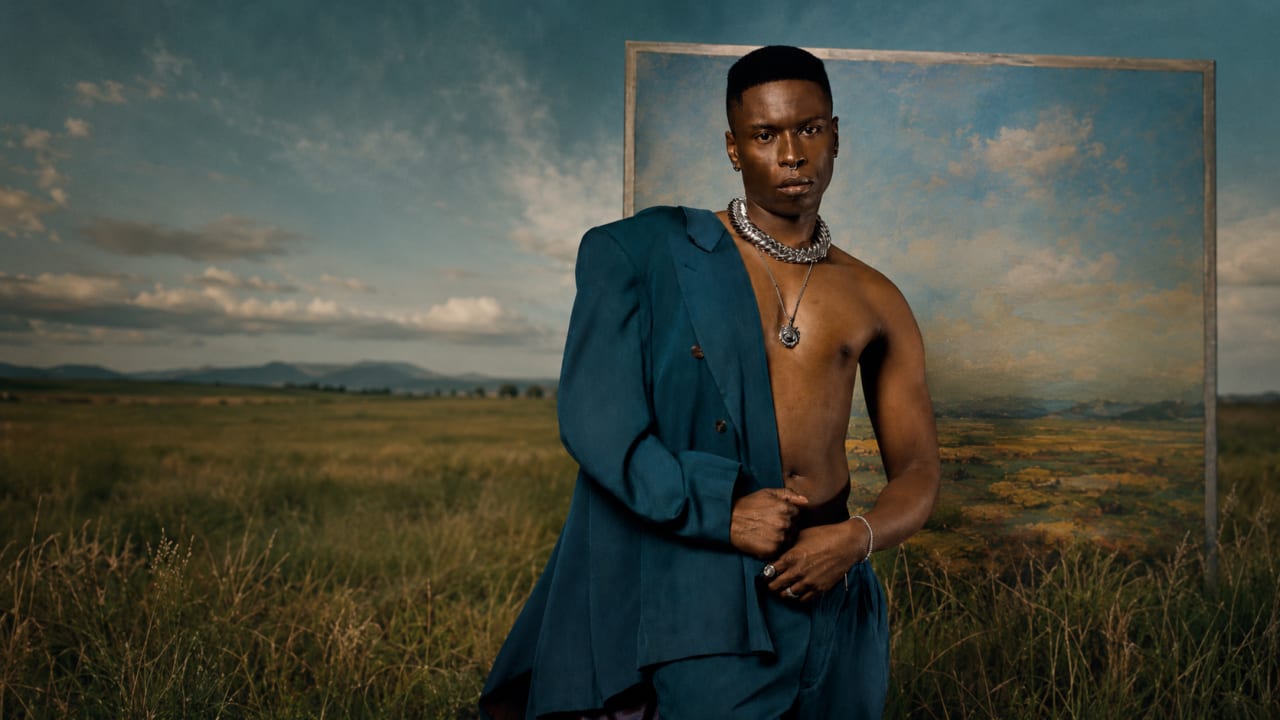
Clinical language has a way of flattening human emotion.
Words like “depression” or “trauma” can look clean on a therapist’s notepad, but they often fail to capture the heavy, sinking, deeply spiritual weight of the actual experience.
On his newly released 18-track album, Ndingubani, Bongeziwe Mabandla moves beyond purely clinical language and treats emotional struggle as something spiritual, embodied and deeply human.
Released through Black Major, Ndingubani translates to “Who am I?” — a terrifyingly simple question that anchors the project. Mabandla has always been a masterful storyteller, but here the narrative turns inward. He is not only singing about pain. He is interrogating the exhaustion of existence.
Take a track like “Ndikhulule (Depression).”
Mabandla does not approach the subject like a public service announcement. He frames it as a kind of imprisonment, a suffocation that requires release. His voice, steeped in Xhosa folk-soul, carries a weathered authority. When he sings about pain, it does not sound like a neat modern diagnosis. It sounds like something older, heavier and more inherited that has to be sung out of the body.
Then there is “Libambe Lingatshoni,” one of the album’s most resonant moments.
It carries the feeling of pleading for the light to stay a little longer before the dark arrives. Mabandla uses the natural world — fading light, distance, the long road — to explain perseverance in a way that feels immediately understood.
There is comfort in this approach.
By wrapping themes of emotional exhaustion and vulnerability in acoustic warmth, indigenous storytelling and spiritual language, Mabandla removes some of the coldness that often surrounds conversations about mental health.
Ndingubani does not offer a prescription.
It does not pretend to cure the wound.
It offers solidarity.
It makes the act of surviving your own mind sound less like a private failure and more like a sacred, deeply human rite of passage.
Story index Key points, people & topics
Key points & topics
- On Ndingubani, Bongeziwe Mabandla turns emotional struggle, depression and self-questioning into something spiritual, embodied and deeply human.
- Bongeziwe Mabandla’s Ndingubani does not treat mental health like a slogan. It turns depression, exhaustion and self-questioning into ritual, song and shared human survival.
- Bongeziwe Mabandla’s Ndingubani explores mental health, identity, depression and resilience through Xhosa folk-soul, spiritual storytelling and emotional solidarity.
Credibility & transparency How this story is reported
Edited under our Editorial Standards and How We Report process. Spotted an error? Open the correction form below, or email corrections@viranova.co.za.
Request a correction Accuracy desk
Submit a Correction
Corrections are reviewed by editors and logged with the story record.
Human-written · Editor-reviewed · Corrections open
Filed by Viranova Music Desk for the Music desk · South Africa. Published 17 Jun 2026.
Respond to this story Reactions, comments, corrections
Respond to this story. Share a comment, a correction, or a right-of-reply — comments open once the room starts talking.