

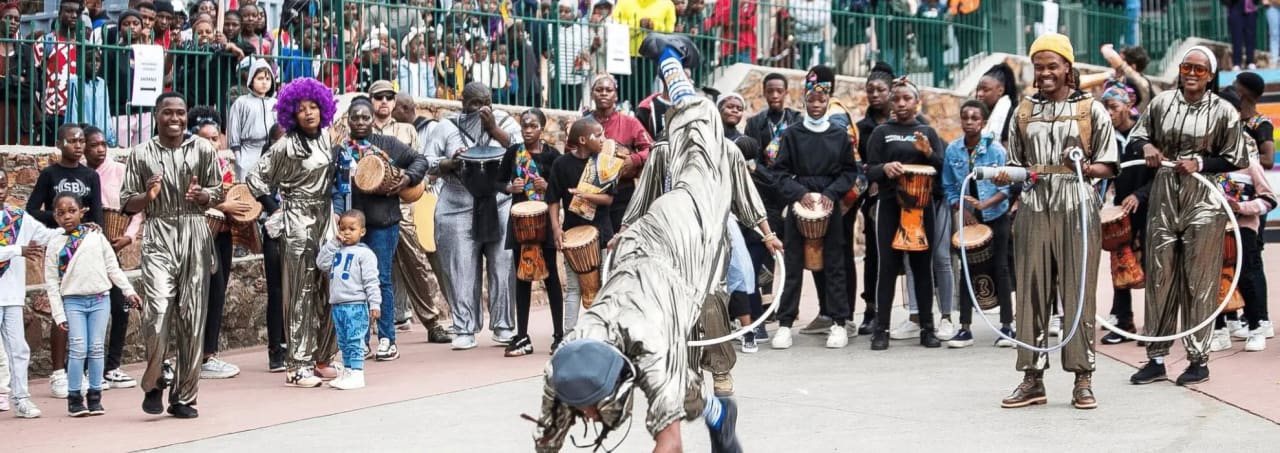
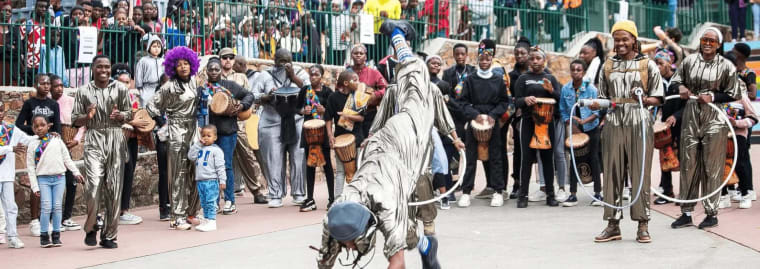
Who gets to decide what Johannesburg looks and sounds like? On an ordinary day, the answer appears to belong to property owners, advertisers, municipal systems, traffic and the people with enough power to make their version of the city permanent. On 8 August 2026, more than 350 children and young people from Hillbrow and beyond will offer a different answer when the seventh Hey Hillbrow! Let’s Dlala! procession moves through the neighbourhood.
This story matters because Hillbrow is often discussed through crisis, pressure and urban risk. Hey Hillbrow! Let’s Dlala! shifts that frame by placing children and young people at the centre of public imagination, allowing them to shape the visual and sonic identity of the neighbourhood for a day.
Presented by the Windybrow Arts Centre and Shade with community organisations and artists, the annual event turns Hillbrow’s streets into a public performance space. The 2026 theme is “ARISE”, a bird-driven meditation on freedom, migration, warning and collective movement. Handmade costumes, birdsongs, dance, theatre and street-scale visual work will gather the participants into what organisers describe as a living flock.
The bird imagery is not decorative. Curator Tamzyn Botha has framed migration as a way of thinking about movement across land, language, history and borders. Gerard Bester, head of the Windybrow Arts Centre, points specifically to the grey go-away bird, or lourie, whose call warns the bushveld of danger. In the procession, that alarm becomes a creative signal: a cry that gathers people, protects community and transforms fear into play.
The date adds another layer. The parade takes place on the eve of the 70th anniversary of the Women’s March of 9 August 1956, when thousands of women marched to the Union Buildings against pass laws. Hey Hillbrow! connects the image of a cage with the historical restriction of movement under apartheid. The young participants’ birds become symbols of the right to occupy space, cross boundaries and be heard.
That symbolism is built through weeks of practical work rather than attached to the event at the last minute. Workshops leading into the procession have included textile-making, street art, choral music, physical theatre and site-specific performance. Young people are not being placed into costumes designed entirely by adults and told where to stand. The programme invites them to co-design the material, shadow artists and production teams and learn how a large public artwork is assembled.
The participating network is as important as the final spectacle. Organisations connected to the procession include Dlala Nje, the Dlamini Foundation, the Johannesburg Society for the Blind, Innovation of Excellence, Lefika La Phodiso, Fight with Insight, MES, Shade and the Windybrow Arts Centre. The breadth of the collaboration resists the idea that public culture must be delivered to Hillbrow from outside. The neighbourhood’s own youth programmes and social organisations are part of the artistic infrastructure.
Hey Hillbrow! Let’s Dlala! was launched in 2017 and was inspired by the late Johannesburg public-art advocate Lesley Perkes. Its underlying idea is simple but politically meaningful: public performance can change the emotional use of public space. For a few hours, a street associated with movement, pressure and urban risk can become a place of organised joy, surprise and attention.
The procession will begin at the Windybrow Arts Centre at 10:00 and close with Kebra Ethiopian Sound System. That ending matters. The children’s visual flock gives way to a shared sound system and dance floor, allowing the event to move from something watched to something inhabited.
Calling the parade ‘cute’ would miss the seriousness of the work. More than 350 young people will temporarily govern the visual and sonic identity of their neighbourhood. They will carry memory, warning, migration and freedom through streets usually shaped by adult power. For one day, Hillbrow’s children are not being discussed as a social problem or a population to be managed. They are becoming the city’s public artists.
Reporting basis: Based on the official 2026 Hey Hillbrow! Let’s Dlala! event announcement, Market Theatre Foundation/Windybrow Arts Centre information, Artslink publication of the release, GroundUp reporting on earlier Hey Hillbrow! processions, and Viranova editorial analysis of public space, youth participation and urban cultural visibility.
Story index Key points, people & topics
Key points & topics
- The seventh Hey Hillbrow! Let’s Dlala! procession will turn more than 350 children and young people into a living flock of public artists moving through the streets of Hillbrow.
- Who gets to decide what Johannesburg looks and sounds like? On an ordinary day, the answer appears to belong to property owners, advertisers, municipal systems, traffic and the people with enough power to make their version of...
Frequently asked Answers from the desk
What is Hey Hillbrow! Let’s Dlala!?
Hey Hillbrow! Let’s Dlala! is an annual public-art procession that turns Hillbrow’s streets into a space for performance, play, music, movement and community visibility. When is Hey Hillbrow! Let’s Dlala!
2026?
The 2026 procession takes place on Saturday, 8 August 2026.
Where does the procession start?
It starts at 10:00 from The Windybrow Arts Centre in Hillbrow, Johannesburg.
What is the 2026 theme?
The 2026 theme is ARISE, using bird imagery to explore freedom, migration, warning and collective movement. Who presents Hey Hillbrow! Let’s Dlala!
?
The 2026 edition is presented by The Windybrow Arts Centre and Shade in collaboration with community organisations and artists.
How many young people are involved?
The 2026 procession works with more than 350 children and young people from Hillbrow and beyond.
Which organisations are involved?
Participating organisations include Dlala Nje, Shade, Dlamini Foundation, Johannesburg Society for the Blind, Innovation of Excellence, Lefika La Phodiso, Fight with Insight, MES and The Windybrow Arts Centre.
Why are birds central to the 2026 theme?
Birds are used as symbols of migration, freedom, warning, communication and collective movement, with the grey go-away bird or lourie inspiring part of the procession’s creative language.
Why does the date matter?
The parade takes place on the eve of the 70th anniversary of the 1956 Women’s March, connecting the theme of freedom of movement to South African historical memory. Why does Hey Hillbrow! Let’s Dlala!
matter?
It matters because it allows children and young people to become visible makers of public culture in Hillbrow, changing how the neighbourhood is seen, heard and experienced.
How we reported this Sources, verification & accountability
- Reporting type
- News
- Verification
- Verified — multiple sources
- Reporter / responsible desk
- Viranova Editorial Desk
- Primary evidence
- Based on the official 2026 Hey Hillbrow! Let’s Dlala! event announcement, Market Theatre Foundation/Windybrow Arts Centre information, Artslink publication of the release, GroundUp reporting on earlier Hey Hillbrow! processions, and Viranova editorial analysis of public space, youth participation and urban cultural visibility.
- Additional verification
- This story is based on Market Theatre Foundation/Windybrow Arts Centre event information, Artslink, GroundUp, Johannesburg in Your Pocket context and Viranova analysis of public art, youth-led performance and Hillbrow’s cultural infrastructure.
- Primary source
- markettheatre.co.za
Edited under our Editorial Standards and How We Report process. Spotted an error? Open the correction form below, or email [email protected].
Request a correction Accuracy desk
Submit a Correction
Corrections are reviewed by editors and logged with the story record.
Human-written · Editor-reviewed · Corrections open
Filed by Viranova Editorial Desk for the Artists & Creatives desk · Hillbrow, Johannesburg, South Africa. Published 25 Jul 2026.
Culture worth
opening.
Two sharp culture reads a week — no algorithm in between.
Join the conversation React or leave a thoughtful comment
How did this story land?