

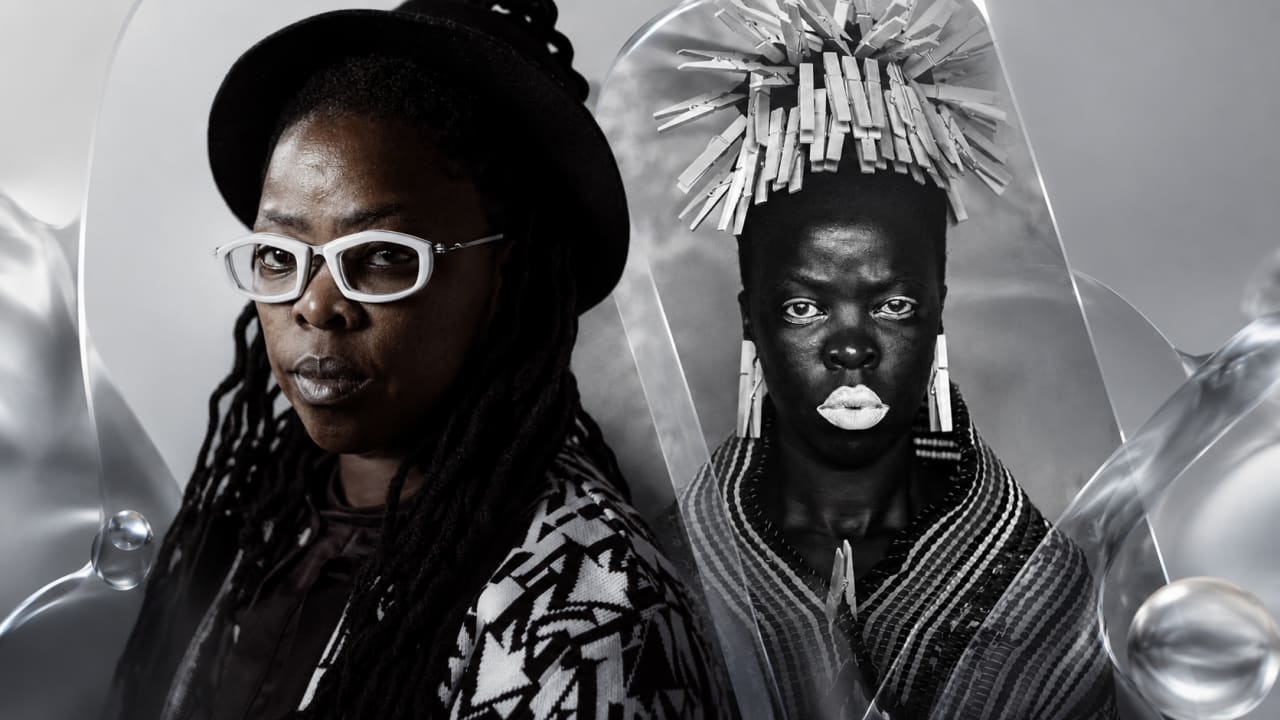
The major Cape Town exhibition gathers more than 20 years of work around visibility, memory and collective care.
This story matters because Muholi’s work has long challenged the erasure and distortion of Black LGBTQIA+ lives in public memory. Kanye Nawe brings that archive into one Cape Town space, showing visibility not as spectacle, but as care, documentation, dignity and refusal.
On 18 July 2026, Southern Guild opened Kanye Nawe, a major solo exhibition by South African visual activist Zanele Muholi at its Cape Town gallery in the V&A Waterfront’s Silo District.
The exhibition runs until 10 September and occupies the entire gallery. It brings together photography and sculpture spanning more than two decades of Muholi’s practice.
Muholi enters the exhibition as the recipient of the 2026 Hasselblad Award, one of photography’s most significant international honours. The award includes SEK2 million, a gold medal and a Hasselblad camera, with the formal ceremony and related programme scheduled for October in Gothenburg.
The title, Kanye Nawe, can be translated from isiZulu as “with you,” “alongside you” or, more broadly, “oneness.” It also invokes a hymn familiar within many Black South African Christian traditions, whose meaning extends toward the idea of walking each day with God.
That spiritual reference should not be treated as decorative. It frames the exhibition around accompaniment: who is seen, who is remembered, who remains present, and how one person’s dignity becomes connected to another’s responsibility to witness.
The exhibition is sometimes described as a homecoming, but that word requires qualification. Muholi has continued showing work in South Africa, including a major self-titled Southern Guild exhibition in Cape Town in 2023. Kanye Nawe is therefore not the first return of their work to home soil after years of complete absence. It is a significant new home presentation following an intense period of international exhibitions, research and travel.
Nor should Kanye Nawe be described as an exhaustive retrospective. Although it spans more than two decades, it does not present Muholi’s career through a neat, chronological survey. Reporting around the exhibition explicitly distinguishes it from a conventional retrospective: the work looks backward in order to carry its participants and histories forward.
At its centre is Faces and Phases, Muholi’s long-running portrait project marking its 20th anniversary in 2026.
Begun in South Africa in 2006, the series responded to violence and hate crimes directed at Black queer communities, as well as their absence and distortion within public and historical records. It has since grown into a transnational archive encompassing participants photographed across several continents.
In Kanye Nawe, early portraits made in South Africa appear alongside more recent additions produced in London, Porto, Panama City, Los Angeles, Salvador, São Paulo, Venice and Rio de Janeiro. That geographical expansion does not transform the project into a simple catalogue of international travel. It demonstrates how the original questions of visibility, dignity and historical preservation continue beyond one national boundary.
The exhibition also includes photographs from Only Half the Picture, Being, Mo(u)rning, LiZa and ZaVa. Across those bodies of work, intimacy, desire, grief, vulnerability and queer relationships are treated as forms of historical evidence—not private experiences too minor to enter the archive.
Recent works from Somnyama Ngonyama (Hail the Dark Lioness) turn the camera toward Muholi’s own body. Produced in response to locations, objects and encounters during periods of travel, the self-portraits examine histories of race, labour, gender, sexuality and representation. The exhibition includes recent images made in Cape Town, Paternoster, London, Los Angeles, Panama City, Rio de Janeiro and Venice.
The draft’s descriptions of these works as theatrical and highly charged are interpretive but defensible. What should be avoided is reducing the series to a single message. Muholi’s body operates simultaneously as subject, material, archive, visual intervention and site of self-authorship.
Kanye Nawe also includes three large-scale bronze sculptures. Southern Guild describes them as works shaped by personal memory, spirituality and the body, exploring protection, mourning, ancestry and survival.
The original draft named these sculptures as Ncinga, Bambatha and The Uterus. That list could not be verified against the official Kanye Nawe exhibition material.
Muholi has created earlier bronze sculptures connected to clitoral anatomy, uterine imagery and the body, including Ncinda and Bambatha I. Those works were associated with their 2023 self-titled exhibition and later presentations. Their existence does not prove that they are the three new bronzes shown in Kanye Nawe. The unconfirmed titles should therefore not be assigned to this exhibition.
The exhibition’s timing contains several confirmed anniversaries.
It opened one day before Muholi’s 54th birthday on 19 July. It marks 20 years since the beginning of Faces and Phases, 20 years since South Africa enacted the Civil Union Act and the 30th anniversary of the Constitution. It also arrives during the 70th anniversary year of the 1956 Women’s March and the 50th anniversary of the Soweto uprising.
Reporting around the exhibition has also connected 2026 to 20 years since the deaths of Muholi’s nephew Nkanyiso and friends during the HIV/AIDS epidemic. Because this is a sensitive personal claim, it should be attributed rather than presented as a detail inferred from the artwork.
These anniversaries do not create a mystical “historical synchronicity.” They create a dense context in which personal memory, queer history and national commemoration overlap.
The philosophy running through Kanye Nawe is one of collective care. Southern Guild describes the title as expressing shared presence, while Muholi’s practice remains committed to documenting and celebrating Black LGBTQIA+ lives against historical erasure.
That commitment is not abstract academic language. Faces and Phases preserves people as participants in history rather than anonymous evidence of suffering. The relationship photographs insist that tenderness and desire belong inside public memory. The self-portraits reclaim control over the representation of Muholi’s own body. The sculptures translate vulnerability and survival into physical mass.
The work has not come home for the first time, and it has not come home merely to be admired.
Kanye Nawe gathers a living archive inside one space and asks what it means to remain with other people—to witness them, remember them and refuse the conditions that make their lives disappear.
Reporting basis: Based on Southern Guild’s official Kanye Nawe exhibition information, Southern Guild artist-profile context, Hasselblad Foundation information on Zanele Muholi as the 2026 Hasselblad Award laureate, Mail & Guardian reporting on the exhibition and anniversary context, South African History Online biographical information, government anniversary records and Viranova editorial analysis of visual activism, queer archive and collective care.
Story index Key points, people & topics
Key points & topics
- The major Cape Town exhibition gathers more than 20 years of Zanele Muholi’s work around visibility, memory, Black LGBTQIA+ life and collective care.
- Zanele Muholi’s Kanye Nawe gathers photography and sculpture from more than two decades of visual activism, asking what it means to witness, remember and remain with Black LGBTQIA+ lives.
- Zanele Muholi’s Kanye Nawe opens at Southern Guild Cape Town, gathering more than two decades of photography and sculpture around Black queer visibility and care.
Frequently asked Answers from the desk
What is Zanele Muholi’s Kanye Nawe?
Kanye Nawe is a major solo exhibition by South African visual activist Zanele Muholi at Southern Guild Cape Town, bringing together photography and sculpture spanning more than two decades of practice.
When does Kanye Nawe run?
Kanye Nawe runs at Southern Guild Cape Town from 18 July to 10 September 2026.
What does Kanye Nawe mean?
Kanye Nawe is an isiZulu phrase that can mean “with you,” “alongside you” or “oneness.
” Where is Kanye Nawe showing?
The exhibition is showing at Southern Guild Cape Town in the V&A Waterfront’s Silo District.
What is Faces and Phases?
Faces and Phases is Muholi’s long-running portrait project, begun in 2006, documenting Black lesbian, queer, trans and gender-nonconforming participants with dignity and historical presence.
Why is 2026 important for Faces and Phases?
2026 marks 20 years since Muholi began Faces and Phases.
What award did Zanele Muholi win in 2026?
Muholi was named the 2026 Hasselblad Award laureate, receiving one of photography’s most prestigious international honours.
Is Kanye Nawe a retrospective?
Kanye Nawe spans more than two decades of work, but it is better described as a major solo presentation and living archive rather than a conventional chronological retrospective.
Why does Kanye Nawe matter?
It matters because it gathers Muholi’s visual activism around Black LGBTQIA+ life, memory, intimacy, self-representation and collective care at a major South African exhibition moment.
How we reported this Sources, verification & accountability
- Reporting type
- News
- Verification
- Verified — multiple sources
- Reporter / responsible desk
- Viranova Visual Desk
- Primary evidence
- Based on Southern Guild’s official Kanye Nawe exhibition information, Southern Guild artist-profile context, Hasselblad Foundation information on Zanele Muholi as the 2026 Hasselblad Award laureate, Mail & Guardian reporting on the exhibition and anniversary context, South African History Online biographical information, government anniversary records and Viranova editorial analysis of visual activism, queer archive and collective care.
- Additional verification
- This story is based on Southern Guild, Hasselblad Foundation, Mail & Guardian, Glamour South Africa, Time Out Cape Town, South African History Online and public South African government anniversary context. The exhibition is treated as a significant new home presentation rather than the first return of Muholi’s work to South Africa, because Southern Guild also presented a major Muholi exhibition in Cape Town in 2023.
- Primary source
- southernguild.com
Edited under our Editorial Standards and How We Report process. Spotted an error? Open the correction form below, or email [email protected].
Request a correction Accuracy desk
Submit a Correction
Corrections are reviewed by editors and logged with the story record.
Human-written · Editor-reviewed · Corrections open
Filed by Viranova Visual Desk for the Artists & Creatives desk · Cape Town, South Africa. Published 19 Jul 2026.
Leave with the sharp version of what moved.
Two considered South African culture reads a week. No feed to chase, no noise between them.
Join the conversation React or leave a thoughtful comment
Respond to this story. Share a comment, a correction, or a right-of-reply — comments open once the room starts talking.