

Photographic archives often present themselves as evidence: fixed records that appear to tell viewers what happened.
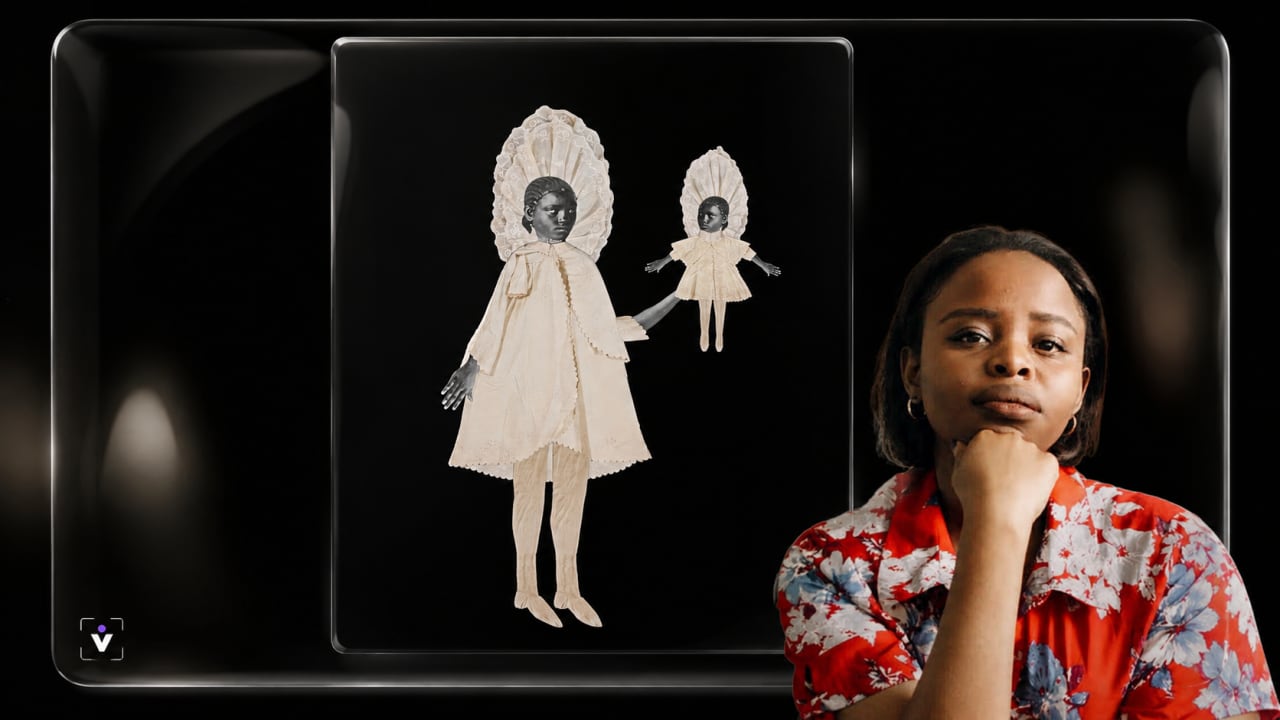
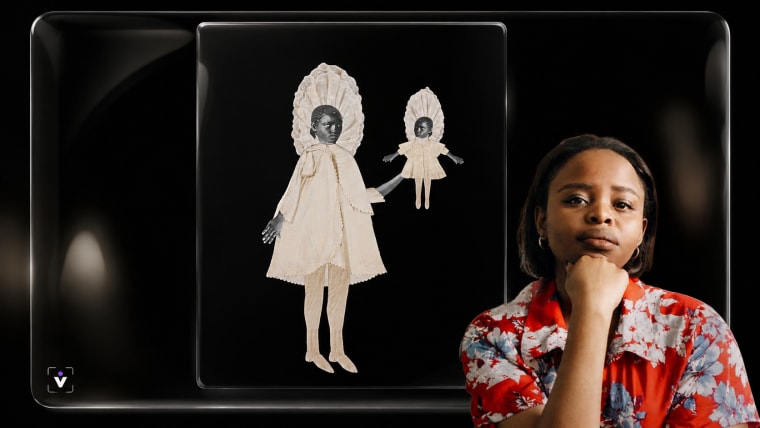
For Johannesburg-based collage artist Tshepiso Moropa, an archive is not a closed account. It is material that can be cut, rearranged and reopened.
Moropa, born in 1995, is a self-taught artist with formal academic training from the University of the Witwatersrand. She completed a bachelor’s degree in psychology and linguistics in 2019 and an honours degree in linguistics in 2022. Her practice works across digital and analogue collage, combining archival imagery, memory, dreams, oral traditions and personal material.
She has presented work with THK Gallery and at international platforms including 1-54 London, the V&A in London and Museum Rietberg’s A Kind of Paradise in Zurich. The original wording that she was “represented by galleries like THK” has been replaced because the available material most clearly confirms exhibitions and presentations with THK rather than a broad list of formal gallery representation.
Two Setswana concepts are central to her recent work: Dinaane, meaning folktales, and Ditoro, meaning dreams. THK Gallery describes them as connected knowledge systems rather than separate sources of inspiration. Within this framework, “Ditoro ga di tle fela” means that dreams are not random.
Moropa’s suspended figures, altered scale and overlapping timeframes refuse the idea that archival photographs possess one final meaning. Personal and public images can be placed in conversation, allowing historical material to interact with memory, intuition and inherited knowledge.
The original draft supplied a detailed visual description of Hiding in Plain Sight, including anonymous colonial subjects, wooden houses and specific family photographs. While the work exists, the precise identification of every image source could not be independently verified and has therefore not been repeated as fact.
That removal does not weaken the argument. Moropa’s documented practice is already built around combining archival and personal imagery to challenge photography’s claim to objective truth.
Her collages do not pretend that imagination can repair every historical absence. Instead, they make those absences visible and refuse to allow official archives to remain the only authorities on African life.
The result is not simply nostalgia. It is an active reconstruction of the relationship between history, family, folklore and the present.
Reporting basis: Based on THK Gallery’s artist profile and CV for Tshepiso Moropa, Ocula/THK exhibition information for Dinaane, Ditoro, and the Work of Imagining Otherwise, Museum Rietberg’s A Kind of Paradise exhibition information, public art coverage and Viranova editorial analysis of collage, archival memory and Setswana knowledge systems.
Story index Key points, people & topics
Key points & topics
- Through collage, archival imagery, Dinaane and Ditoro, Johannesburg-based artist Tshepiso Moropa reopens photographic archives as living spaces where memory, dreams, family and Setswana knowledge can be rearranged.
- Tshepiso Moropa’s collage practice turns archival photographs into living material, using Setswana folktales, dreams and memory to challenge the idea that archives carry one final truth.
- Photographic archives often present themselves as evidence: fixed records that appear to tell viewers what happened.
Frequently asked Answers from the desk
Who is Tshepiso Moropa?
Tshepiso Moropa is a Johannesburg-based South African collage artist born in 1995, known for working with archival imagery, memory, dreams and oral traditions.
What did Tshepiso Moropa study?
Moropa completed a B.A. in Psychology and Linguistics at the University of the Witwatersrand in 2019 and a B.A. Honours in Linguistics in 2022.
What do Dinaane and Ditoro mean in Tshepiso Moropa’s work?
Dinaane refers to Setswana folktales, while Ditoro means dreams. In Moropa’s practice, they function as connected systems of memory, inheritance and imagination.
What does “Ditoro ga di tle fela” mean?
“Ditoro ga di tle fela” means that dreams are not random.
Why does Tshepiso Moropa’s collage work matter?
Her work matters because it challenges the idea that photographic archives carry one fixed truth, using collage to reopen histories through memory, family, folklore and imagination.
Credibility & transparency How this story is reported
- Content type
- News
- Verification
- Verified — multiple sources
- Reporting basis
- Based on THK Gallery’s artist profile and CV for Tshepiso Moropa, Ocula/THK exhibition information for Dinaane, Ditoro, and the Work of Imagining Otherwise, Museum Rietberg’s A Kind of Paradise exhibition information, public art coverage and Viranova editorial analysis of collage, archival memory and Setswana knowledge systems.
- Sources & context
- This story is based on THK Gallery artist information, THK’s artist CV, Ocula/THK exhibition material, Museum Rietberg’s A Kind of Paradise listing, Colossal coverage of Moropa’s archival collages, The Photographic Collective artist context and Viranova analysis of how Moropa’s practice challenges fixed readings of photographic archives.
- Primary source
- thkgallery.com
Edited under our Editorial Standards and How We Report process. Spotted an error? Open the correction form below, or email corrections@viranova.co.za.
Request a correction Accuracy desk
Submit a Correction
Corrections are reviewed by editors and logged with the story record.
Human-written · Editor-reviewed · Corrections open
Filed by Viranova Visual Desk for the Artists & Creatives desk · Johannesburg, South Africa. Published 13 Jul 2026.
Leave with the sharp version of what moved.
Two considered South African culture reads a week. No feed to chase, no noise between them.
Respond to this story Reactions, comments, corrections
Respond to this story. Share a comment, a correction, or a right-of-reply — comments open once the room starts talking.