

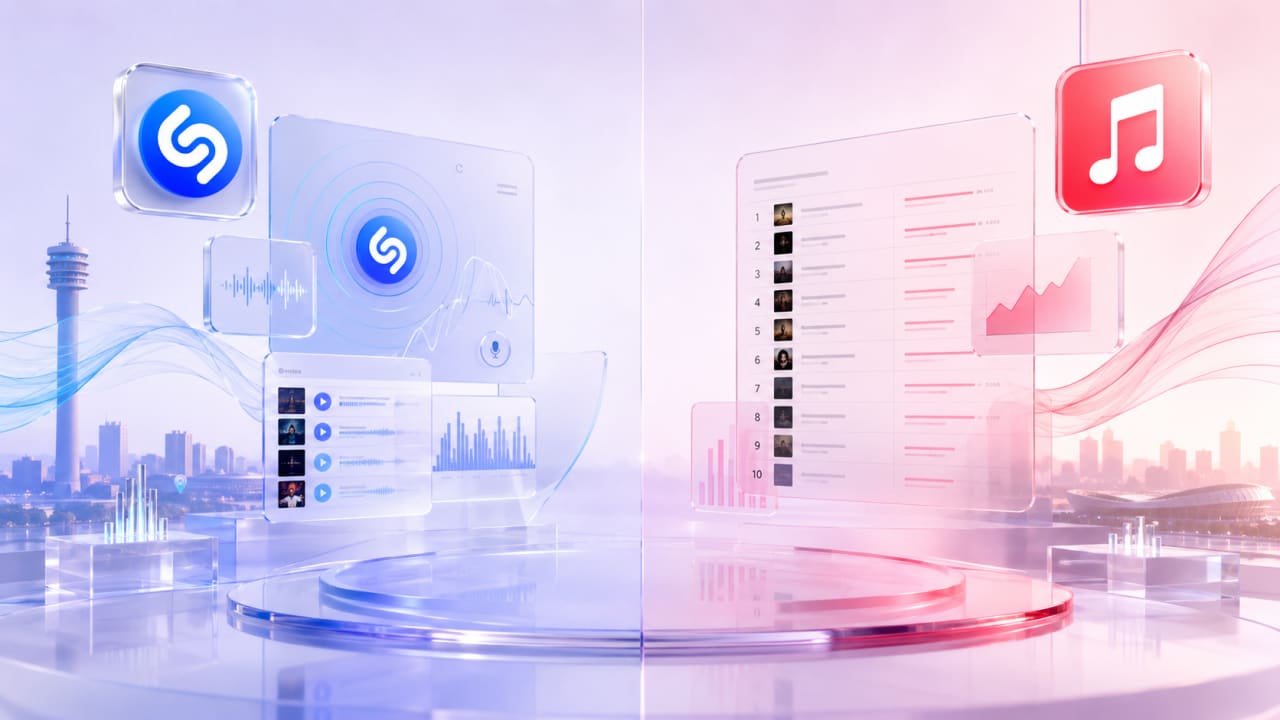
If you want to understand the split personality of South African music consumption, look at two different chart environments.
On one side, Apple Music’s South Africa Top 100 can sometimes feel like an extension of global rap and pop momentum. Apple describes the playlist as “the most-played songs in South Africa,” updated every day, and as of this check, Drake occupies several of the leading positions, including tracks such as “Janice STFU,” “Shabang,” “Whisper My Name” and “Ran To Atlanta” with Future and Molly Santana.
That does not mean the chart is fake or irrelevant. It means Apple Music captures sustained listening behaviour: repeat plays, fanbase loyalty, platform momentum and the catalogue power of major global artists.
Switch over to Shazam’s South Africa chart, and you often see a different kind of country speaking back.
Shazam captures active discovery: the moment someone hears a song in a taxi, tavern, shopping centre, at groove or online, and immediately wants to know what it is. As of this check, Shazam’s South Africa chart includes Calvin Fallo’s “Everybody Wanna Be In Love,” JAZZWRLD, Thatohatsi and Thukuthela’s “Ningikhonzele,” Feza’s “Sengithole Omunye,” and Ba Bethe Gashoazen and Nova sa style’s “Skhethe” near the top.
That divide tells a fascinating story.
Apple Music can reflect sustained streaming power, while Shazam often captures the spark of discovery. One shows what people are repeatedly playing. The other shows what people are urgently trying to identify.
The true battle is not only between local artists and international artists. It is also between two kinds of attention: the algorithmic comfort of global catalogue power and the unpredictable pull of local discovery.
The artists rising on Shazam are not automatically dominating subscription charts, but they are proving something important: street-level discovery remains one of South Africa’s most powerful cultural engines.
Story index Key points, people & topics
Key points & topics
- Apple Music and Shazam reveal two different versions of South African music attention: one shaped by sustained global streaming power, the other by the urgent spark of local discovery.
- Apple Music and Shazam are showing two different sides of South African music consumption: what people repeatedly stream, and what they urgently want to identify when a song catches them in real life.
- If you want to understand the split personality of South African music consumption, look at two different chart environments.
Credibility & transparency How this story is reported
Edited under our Editorial Standards and How We Report process. Spotted an error? Open the correction form below, or email corrections@viranova.co.za.
Request a correction Accuracy desk
Submit a Correction
Corrections are reviewed by editors and logged with the story record.
Human-written · Editor-reviewed · Corrections open
Filed by Viranova Music Desk for the Culture desk · South Africa. Published 25 May 2026.

Respond to this story Reactions, comments, corrections
Respond to this story. Share a comment, a correction, or a right-of-reply — comments open once the room starts talking.