

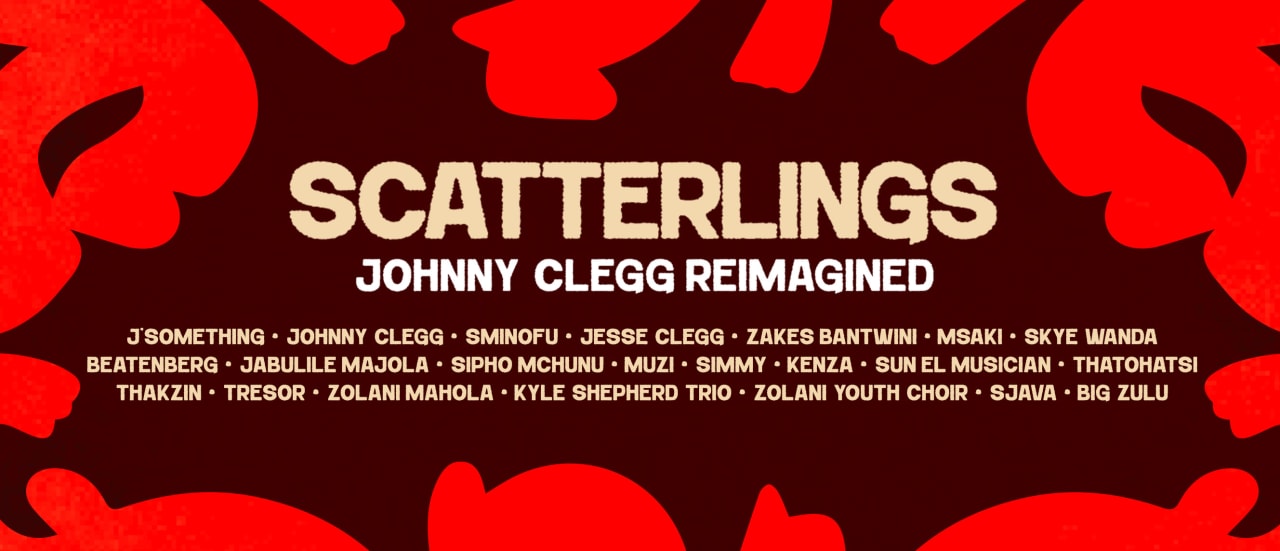
On Scatterlings: Johnny Clegg Reimagined, a new generation of South African artists does more than revisit an iconic catalogue. It enters into conversation with it.
There is a difference between preserving a song and keeping it alive.
Preservation can protect music from being forgotten, but it can also place it behind glass: respected, carefully maintained and gradually separated from the world that once gave it urgency. Keeping a song alive requires something more difficult. It asks new voices to enter it, challenge it and discover what it can mean in a time its original writer never lived to see.
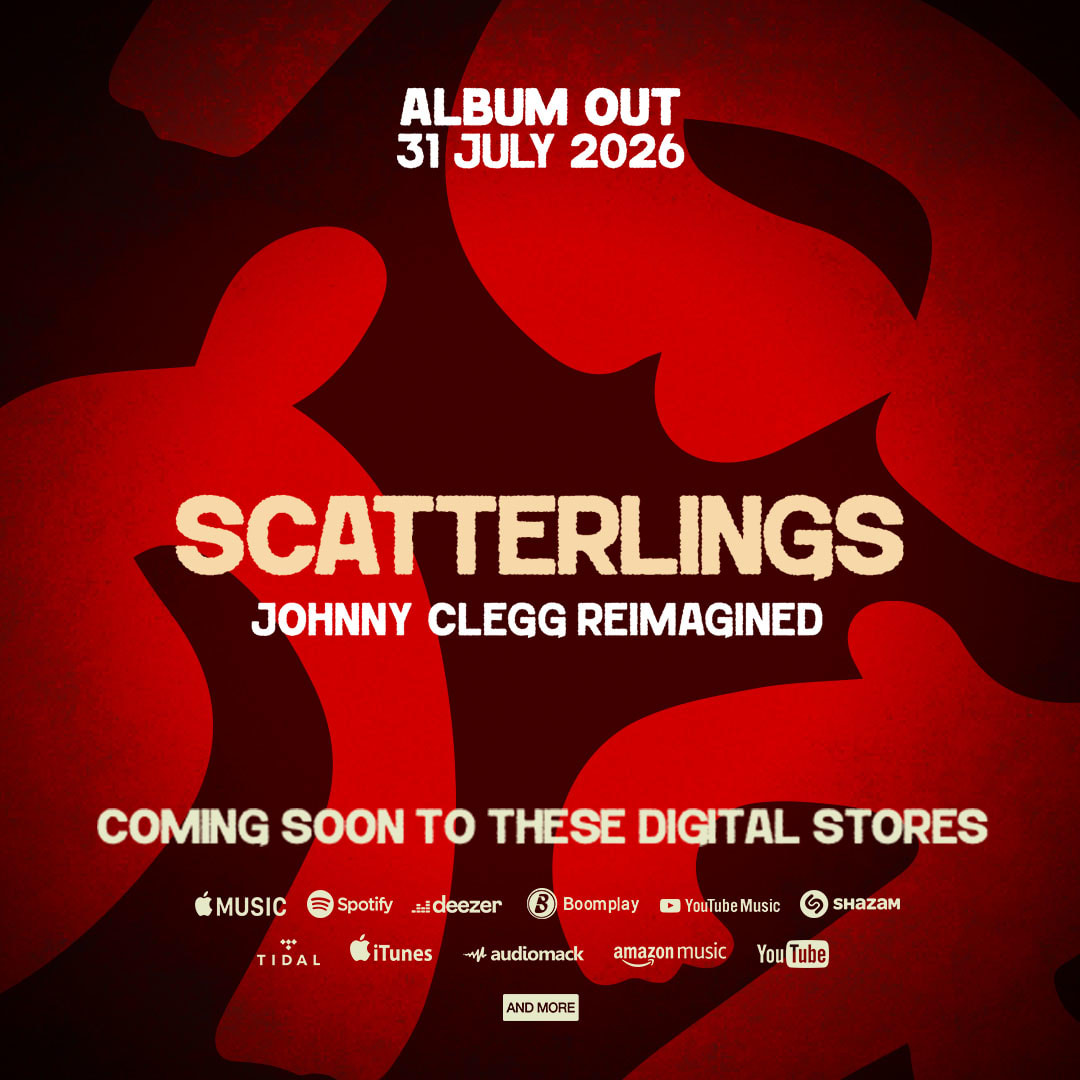
That is the task at the heart of Scatterlings: Johnny Clegg Reimagined, the new album arriving on 31 July.
Bringing together Sjava, Sun-El Musician, Msaki, Zakes Bantwini, TRESOR, Zolani Mahola, Thakzin, Beatenberg, Simmy, MUZI, J’Something, Big Zulu, Jesse Clegg and several other artists, the project returns to Johnny Clegg’s catalogue without attempting to recreate the conditions under which it was first made.
Instead, the album asks a more compelling question: what happens when songs that helped articulate one generation’s experience of South Africa are entrusted to another?
The answer is not a conventional tribute album.
Across its 13 tracks, Scatterlings approaches Clegg’s music as a living archive—one that can accommodate Afro-house, soul, folk, electronic music, Afro-pop and contemporary interpretations without surrendering the emotional and cultural weight of the original compositions.
J’Something opens the project with “Asimbonanga”, while Jesse Clegg revisits “Great Heart” alongside his father’s original presence. Zakes Bantwini, Jesse and Msaki take on “The Crossing” with Skye Wanda. Beatenberg enters “Scatterlings”, MUZI reimagines “Walima”, and Simmy and Kenza bring their voices to “Dela”.
Elsewhere, Sun-El Musician, Msaki and Jesse Clegg are joined by Thatohatsi on “Inkunzi”; Thakzin approaches “Take My Heart Away”; TRESOR interprets “Cruel Crazy Beautiful World”; and Zolani Mahola performs “Osiyeza” with the Zolani Youth Choir.
The breadth of the track listing matters. These are not artists drawn from one movement, generation or interpretation of South African music. They represent different relationships with language, rhythm, memory and the country itself.
Placed together, their contributions show that legacy is not the same as uniformity.
Johnny Clegg’s music has endured partly because it was never interested in remaining within a single cultural or musical enclosure. His songs moved across boundaries and carried complex ideas into public life through melodies that could be intimate, celebratory, mournful and politically resonant at once.
To reimagine that work responsibly, the participating artists could not simply imitate its familiar surfaces. They had to locate themselves within it.
That distinction gives Scatterlings its purpose.
A weaker project might have attempted to prove its respect by reproducing the originals as closely as possible. This album chooses the greater risk of interpretation. Each artist is invited to bring a personal musical language to the material, allowing the songs to encounter the South Africa of 2026 rather than remain permanently fixed within the eras that produced them.
The partnership between Jesse Clegg and Msaki is central to that approach.
As Johnny Clegg’s son, Jesse occupies a deeply personal position within the project. These songs are part of a national catalogue, but they are also bound to his family, his memories and his relationship with his father. Msaki enters from another position: as a songwriter and creative thinker whose work has consistently treated music as a place for emotional, spiritual and social inquiry.
Together, they have shaped an album that understands reverence as something more active than admiration.
“My father always believed that music could bring people together across cultures, languages and generations,” Jesse says.
His most important observation, however, is that the songs “were never meant to stand still”.
That idea transforms the album from a memorial object into a continuation. It recognises that great songs do not survive because every generation hears them in precisely the same way. They survive because each generation discovers its own reason to need them.
Msaki describes the project as “a conversation between generations of South African musicians”. It is an important choice of words.
A conversation does not demand that one generation disappear so another can speak. It allows inheritance and invention to exist together. The original work remains present, but it is no longer the only voice in the room.
That relationship can be seen throughout the collaborations.
On “Impi”, Jesse Clegg, Msaki, Jabulile Majola and Sipho Mchunu appear alongside Johnny Clegg. “The Crossing” expands across multiple voices. “Ibhola Lethu” brings Sjava and Big Zulu into the project, connecting Clegg’s catalogue with two artists whose own music is rooted in contemporary expressions of language, masculinity, place and South African identity.
The inclusion of Johnny Clegg’s original presence across the album further complicates the idea of a remake. The project does not remove him from his songs and replace him with younger performers. Past and present are deliberately allowed to coexist.
That decision makes Scatterlings feel less like a handover and more like an encounter.
It also resists the assumption that younger audiences must approach historically significant music as homework. By allowing artists such as Sun-El Musician, Thakzin, Simmy and MUZI to translate the catalogue through contemporary production and performance languages, the album creates new entrances into songs that may otherwise feel distant to listeners who did not experience their original releases.
Those entrances do not diminish the originals. They widen the number of people who may find their way back to them.
This is where the project’s cultural value may ultimately lie.
South Africa has inherited an enormous body of music that carries its histories, contradictions, grief, imagination and resistance. Yet the survival of that music cannot depend only on anniversaries, commemorations and retrospective praise. A catalogue remains culturally powerful when artists are still willing to wrestle with it—when it continues to provoke interpretation rather than demand passive respect.
Scatterlings: Johnny Clegg Reimagined places Johnny Clegg’s work back into that active space.
It does not argue that the songs need to be rescued. Their place in South African music has already been established. Instead, it demonstrates that importance does not have to result in stillness.
A song can be historically significant and remain open.
It can belong to the moment in which it was written and still find a second life in another.
It can carry the voice of its creator while making room for the voices that follow.
The artists on Scatterlings are not being asked to become Johnny Clegg. They are being asked to meet him through the music—and to respond as themselves.
That may be the most meaningful way to honour a songwriter whose work was built on the possibility of people meeting across difference.
Not by freezing the songs in time, but by allowing them to keep moving.
Scatterlings: Johnny Clegg Reimagined is available on major digital streaming platforms from Friday, 31 July.


Reporting basis: Based on Apple Music pre-release information for Scatterlings, Beatport track listings, public reporting on Scatterlings as a project shaped by Jesse Clegg and Msaki, Johnny Clegg biography context, supplied press material and Viranova editorial analysis of legacy, interpretation and South African music memory.
Story index Key points, people & topics
Key points & topics
- On Scatterlings: Johnny Clegg Reimagined, a new generation of South African artists does more than revisit an iconic catalogue. It enters into conversation with it.
- Scatterlings: Johnny Clegg Reimagined brings contemporary South African artists into conversation with Johnny Clegg’s catalogue, showing that legacy can remain open, moving and alive.
- Scatterlings: Johnny Clegg Reimagined brings Jesse Clegg, Msaki, Sjava, Zakes Bantwini, Sun-El Musician, J’Something and others into conversation with Johnny Clegg’s catalogue.
Frequently asked Answers from the desk
What is Scatterlings: Johnny Clegg Reimagined?
Scatterlings: Johnny Clegg Reimagined is a 2026 album of reinterpreted Johnny Clegg songs performed by contemporary South African artists across generations and genres.
When is Scatterlings: Johnny Clegg Reimagined released?
Apple Music lists Scatterlings for release on 31 July 2026.
How many songs are on Scatterlings?
Apple Music lists Scatterlings as a 14-song album.
Who curated or shaped the Scatterlings project?
Public reporting and press material frame the project as shaped by Jesse Clegg and Msaki.
Which artists appear on Scatterlings?
Artists connected to the project include Jesse Clegg, Msaki, J’Something, Zakes Bantwini, Sjava, Big Zulu, Sun-El Musician, Thakzin, TRESOR, Zolani Mahola, Beatenberg, Simmy, MUZI, Kenza, Skye Wanda, Thatohatsi, Jabulile Majola and Sipho Mchunu.
Which Johnny Clegg songs are reimagined on the album?
Public track listings include reimagined versions of songs such as “Asimbonanga,” “Great Heart,” “The Crossing (Osiyeza),” “Scatterlings,” “Dela,” “Walima,” “Impi,” “Inkunzi,” “Ibhola Lethu,” “Take My Heart Away,” “Woza Friday,” “Third World Child” and “Cruel Crazy World.
” Why does the album matter?
It matters because it treats Johnny Clegg’s catalogue as a living archive, allowing younger and contemporary artists to interpret the songs rather than preserve them as untouchable museum pieces.
Is Johnny Clegg’s original voice included?
Public track listings show Johnny Clegg credited on multiple songs, indicating that his original presence remains part of the album’s reimagined versions.
What is the cultural idea behind Scatterlings?
The project presents Johnny Clegg’s music as a conversation across generations, languages and genres, continuing the cross-cultural spirit that shaped his work.
Credibility & transparency How this story is reported
- Content type
- News
- Verification
- Official source
- Reporting basis
- Based on Apple Music pre-release information for Scatterlings, Beatport track listings, public reporting on Scatterlings as a project shaped by Jesse Clegg and Msaki, Johnny Clegg biography context, supplied press material and Viranova editorial analysis of legacy, interpretation and South African music memory.
- Sources & context
- This story is based on Apple Music, Beatport, IOL, Music In Africa search-indexed release context, Johnny Clegg biography material and supplied press information. Direct quotations from Jesse Clegg and Msaki are treated as supplied press-material quotes.
- Image
- Scatterlings · Supplied by I Be Music
- Primary source
- music.apple.com
Edited under our Editorial Standards and How We Report process. Spotted an error? Open the correction form below, or email corrections@viranova.co.za.
Request a correction Accuracy desk
Submit a Correction
Corrections are reviewed by editors and logged with the story record.
Human-written · Editor-reviewed · Corrections open
Filed by Viranova Music Desk for the Music desk · South Africa. Published 30 Jul 2026.

Respond to this story Reactions, comments, corrections
Respond to this story. Share a comment, a correction, or a right-of-reply — comments open once the room starts talking.